
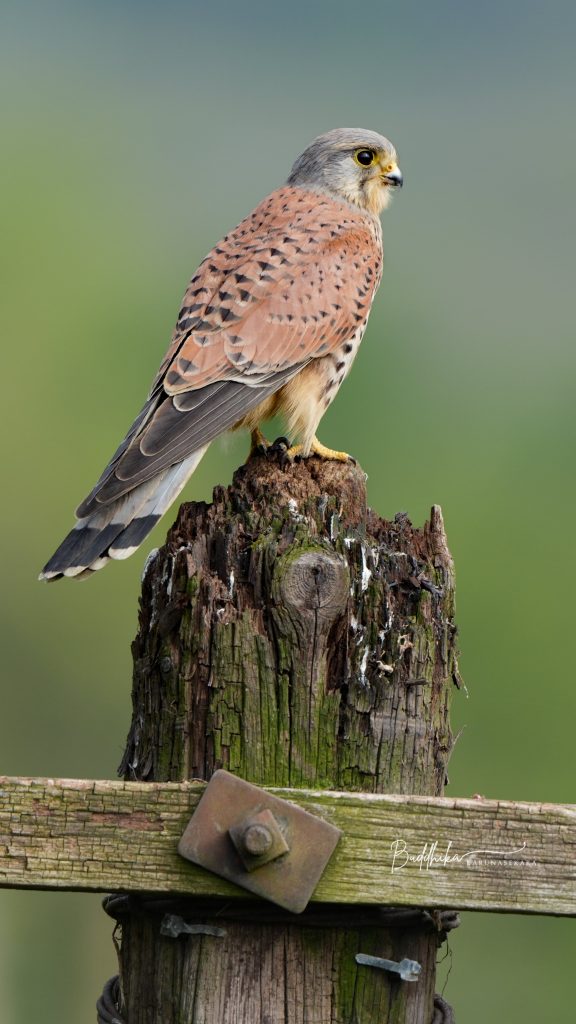
Graceful, alert, and instantly recognisable by its remarkable ability to hover almost motionless in the air, the common kestrel is one of Europe’s most familiar birds of prey. Found across Europe, Asia, and Africa, it inhabits farmland, heathland, open countryside, and increasingly towns and cities. With its russet plumage, sharp eyesight, and effortless command of the wind, the kestrel has long inspired admiration as a symbol of patience, precision, and quiet determination.
Unlike larger falcons that pursue prey through spectacular high-speed chases, the kestrel hunts by hovering into the wind while scanning the ground below. This distinctive behaviour has made it a natural symbol of vigilance and careful observation. For generations, country people have watched kestrels hanging seemingly motionless above fields, waiting patiently for exactly the right moment to strike.
Throughout medieval Europe, birds of prey were closely associated with falconry, where each species became linked with different ranks of society. In the fifteenth-century The Boke of St Albans, the kestrel appears in the famous hierarchy of hawks as “a kestrel for a knave.” Although the bird occupied one of the lower places in this symbolic ranking, the list reflected social custom rather than the kestrel’s true abilities. In reality, its remarkable flying skills and adaptability have earned it lasting admiration from generations of naturalists.
The kestrel occupies a special place in modern British culture through Kes by Barry Hines and the acclaimed 1969 film directed by Ken Loach. The story of a young boy who forms a bond with a wild kestrel has become one of Britain’s most celebrated works of literature and cinema, transforming the bird into a symbol of hope, freedom, and dignity in difficult circumstances. For many people, the kestrel is remembered not only as a hunter but as a reminder of the restorative power of nature.
Across Europe, the kestrel has often been admired as a symbol of freedom and independence. Its effortless mastery of the wind and its ability to thrive in a wide variety of landscapes have encouraged people to see it as an emblem of resilience and adaptability. Although it has never accumulated the dramatic mythology of the eagle or the owl, the kestrel has quietly earned respect through its everyday presence in fields, villages, and open countryside.
Ecologically, the common kestrel plays an important role in maintaining healthy ecosystems. Feeding primarily on small mammals such as voles, together with insects, reptiles, and small birds, it helps regulate prey populations across farmland and grassland. Its reliance on healthy open habitats also makes it an important indicator of the condition of many rural landscapes.
Perhaps that is why the kestrel has remained such an enduring symbol of patience. While larger birds of prey impress with power and spectacle, the kestrel succeeds through precision, persistence, and perfect timing. Suspended effortlessly against the wind, it reminds us that sometimes the greatest achievements come not from rushing forward, but from knowing exactly when to wait, when to watch, and when to act.