
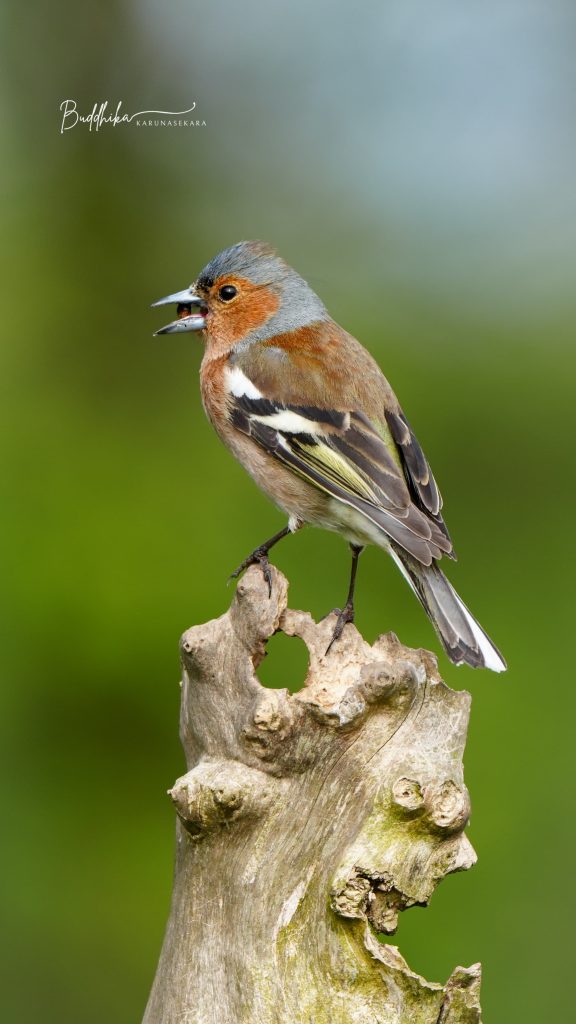
With its rosy breast and blue-grey cap, the Chaffinch has been a familiar sight in British gardens and woodlands for centuries. This charming little bird, with its jaunty call and lively behaviour, has hopped its way into the hearts and imaginations of people across Europe, leaving a trail of tales and traditions in its wake.
In British folklore, the Chaffinch has long been associated with cheerfulness and optimism. Its Latin name, Fringilla coelebs, means ‘bachelor finch’, a nod to the fact that male Chaffinches often overwinter separately from females. This quirk of behaviour spawned the old English saying, “Gay as a Chaffinch”, used to describe someone in high spirits.
The Chaffinch’s distinctive ‘pink pink’ call has inspired various regional nicknames. In parts of England, it’s known as the ‘Spink’ or ‘Pink’, while in Scotland, it’s sometimes called the ‘Shilfa’. These names have found their way into local rhymes and sayings, embedding the bird in the tapestry of regional dialects.
In weather lore, the Chaffinch plays a role as a feathered forecaster. An old country rhyme states, “If the Chaffinch sings in the rain, fine weather is on the way”. Farmers and gardeners would listen keenly for the bird’s song, hoping for a prediction of favourable conditions for their crops.
The bird’s nest-building skills haven’t gone unnoticed in folklore either. Chaffinches are known for their beautifully constructed nests, often decorated with lichen to camouflage them. This led to the belief that finding a Chaffinch nest was a sign of good luck, particularly for matters of the home.
In some parts of Europe, particularly in Germany and the Low Countries, the Chaffinch was once prized as a caged bird for its song. Competitions were held to find the bird with the most melodious voice, a practice that thankfully has since fallen out of favour. However, this history speaks to the high regard in which the Chaffinch’s musical abilities were held.
Celtic mythology paints the Chaffinch in a more mystical light. In some tales, it’s seen as a bird of transformation, able to move between the mortal world and the fairy realm. Its colourful plumage was said to be a gift from the fairies, a reward for its sweet song.
In Christian symbolism, the Chaffinch sometimes appears in religious art, often as a symbol of joy and the resurrection. Its return in spring was seen as a reminder of renewal and hope.
Today, while we may be less inclined to read omens in birdsong, the Chaffinch continues to charm us with its presence. Its cheerful ‘pink pink’ call and bright plumage still bring a spark of joy to gardens and woodlands across Britain and Europe.