
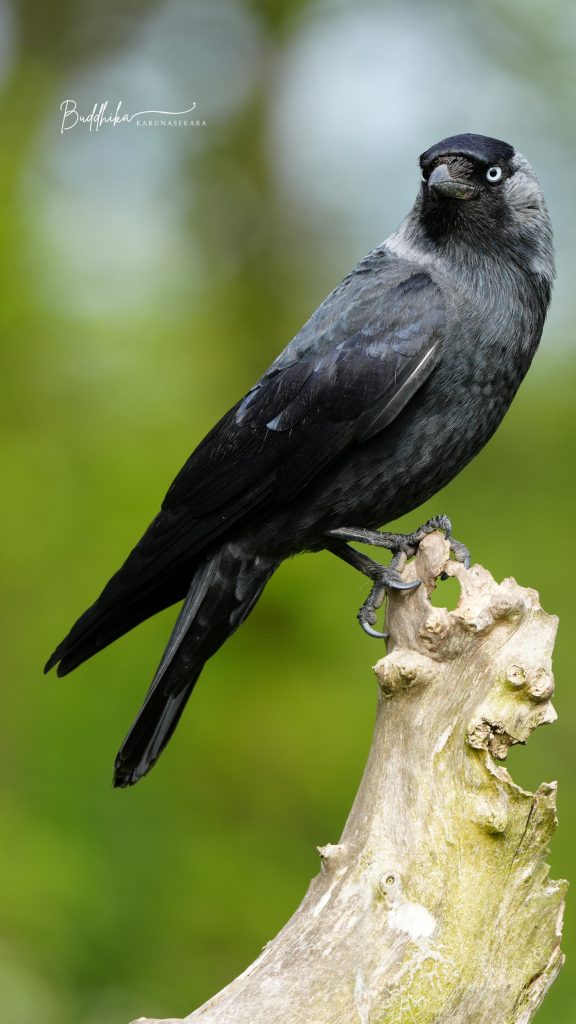
Perched atop church spires or strutting across village greens, the Jackdaw cuts a familiar figure in the British landscape. With its slate-grey plumage and piercing pale eyes, this smallest member of the crow family has long captured the human imagination, hopping its way into our folklore and fables with characteristic cheek.
Unlike its larger cousin the raven, steeped in dark mystique, the Jackdaw’s reputation in folklore is more nuanced. Known scientifically as Corvus monedula, these birds have been our companions in town and country for centuries, their intelligence and sociability earning them a special place in our cultural tapestry.
In many European traditions, Jackdaws are seen as symbols of mischief and theft. Their fondness for shiny objects has led to tales of Jackdaws pilfering jewellery and coins, a trait immortalised in the phrase “thieving magpie” – often mistakenly applied to Jackdaws. This reputation isn’t all negative, though; in some folklore, a Jackdaw arriving at a house was thought to bring wealth and good fortune.
The bird’s name itself has folkloric roots. ‘Jack’ was a common term for a cheeky or mischievous character in English folklore, while ‘daw’ is thought to imitate the bird’s call. Together, they paint a picture of a bird with personality to spare.
In Celtic mythology, the Jackdaw sometimes appears as a messenger between worlds or a shapeshifter. Its intelligence and adaptability made it a fitting symbol for druids and other wise figures in Celtic tales.
The Jackdaw’s habit of nesting in chimneys and church towers has spawned its own set of superstitions. In parts of Britain, it was once believed that if Jackdaws abandoned a church tower, the church would fall. Conversely, Jackdaws nesting in a house were seen as a sign of long-lasting prosperity for the inhabitants.
Greek mythology links the Jackdaw to the god Apollo. One tale tells how the god turned a princess into a Jackdaw as punishment for rejecting his advances, explaining the bird’s intelligence as a remnant of its human origins.
In Aesop’s Fables, the Jackdaw appears in several stories, often portrayed as clever but vain. The tale of “The Jackdaw and the Peacocks” warns against pretending to be something you’re not – a moral that has resonated through the centuries.
The bird’s intelligence has not gone unnoticed in folklore. In many European countries, Jackdaws were believed to be able to predict weather changes or warn of coming danger. Their sudden disappearance from an area was often seen as a portent of doom.
In more recent times, the Jackdaw has found its way into literature. C.S. Lewis features these birds in his Narnia series, where they are intelligent, talking creatures. This portrayal draws on the long-standing folkloric tradition of Jackdaws as clever and almost human-like in their behaviour.
Even in the realm of superstition, Jackdaws hold a special place. In some parts of England, it was once believed that if you see a lone Jackdaw, sorrow will follow. To counteract this, you should bow politely to the bird – a custom that speaks volumes about the respect these birds command.
As we watch Jackdaws today, caching food in urban parks or performing acrobatics on the wind, we’re observing more than just nature at work. We’re witnessing creatures that have lived alongside us for millennia, shaping our stories and beliefs with their antics.