
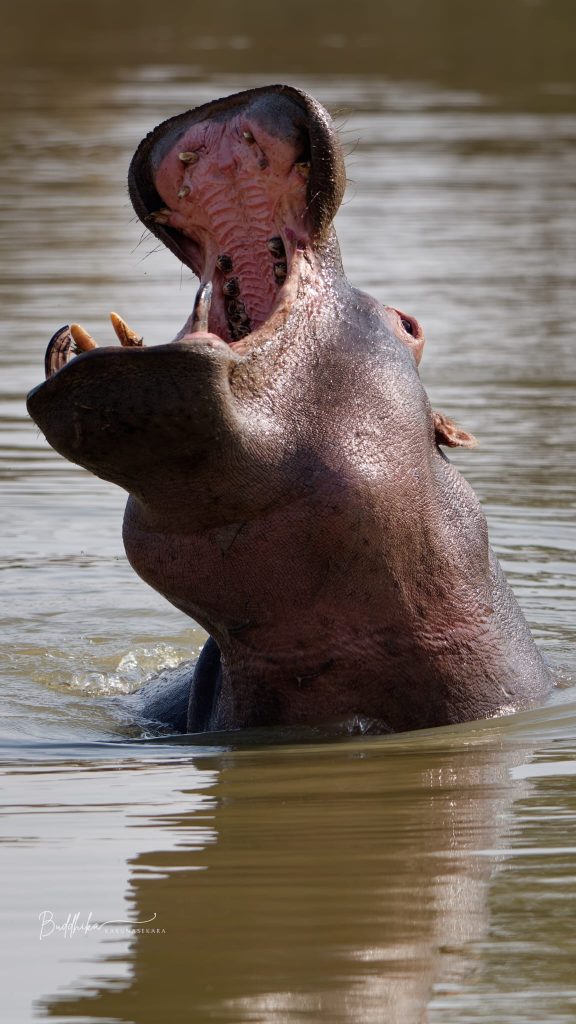
The hippopotamus is one of Africa’s largest land mammals and a dominant presence in rivers and lakes across sub-Saharan Africa. With its heavy body, thick skin, and powerful jaws, it spends most of the day in water to stay cool. Hippos surface regularly to breathe and can remain submerged for several minutes at a time.
Hippos live in groups, often called pods, which may contain several dozen animals. During the day they rest together in water, and at night they leave the river to graze on grass, sometimes travelling a few kilometres along established paths. Although they are herbivores, hippos are highly territorial in water and are responsible for more human fatalities in Africa than most other large animals.
Across many African cultures, the hippopotamus has long been associated with rivers, fertility, and the power of water. Communities living along large rivers often view hippos as signs of a healthy floodplain, where seasonal water supports fish, crops, and wildlife.
In several West African traditions, a well known story explains why the hippopotamus lives in water but eats only grass. In the tale, the hippo once lived fully on land and wished to move into the rivers to escape the heat. The creator allowed this on the condition that it would never eat fish. To prove its promise, the hippo agreed to spread its dung with its tail so that the creator could see it had eaten only grass. The behaviour is still observed today and is often pointed to as evidence that the animal kept its word.
In parts of East Africa, particularly around large lakes and river systems, the hippopotamus is sometimes described as a guardian of the water. Oral traditions tell of travellers who approached rivers carelessly and were reminded by the presence of a hippo that these places demand respect. These stories are often used to teach children to approach water slowly and cautiously.
Some communities also describe the hippo as a boundary keeper between land and water. During the day it belongs to the river, and at night it moves quietly onto land to feed before returning before sunrise. This daily movement has led to stories portraying the hippo as a creature that moves between two worlds, reinforcing the idea that rivers are shared spaces rather than areas fully controlled by people.
Today, these traditional beliefs echo in conservation efforts. The continued presence of hippopotamus populations often signals healthy rivers and wetlands. Protecting the species also protects the waterways and floodplains that support both wildlife and human communities.