
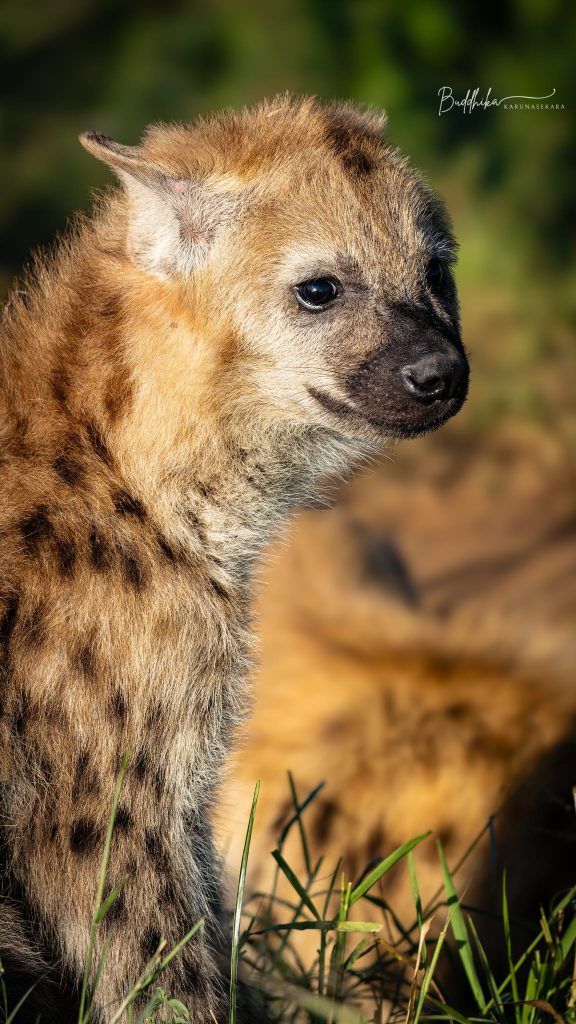
The spotted hyena is one of Africa’s most distinctive and misunderstood carnivores, found across much of sub-Saharan Africa in savannahs, grasslands, and open woodlands. Recognisable by its sloping back, powerful build, and spotted coat, it is both a skilled hunter and an opportunistic scavenger. With one of the strongest bite forces relative to body size among mammals, the spotted hyena is capable of crushing bone and consuming nearly every part of a carcass.
Spotted hyenas live in large, complex social groups known as clans, which can number from a few individuals to over 80 members. These clans are led by dominant females, and the species is notable for its matriarchal social structure, where females are typically larger and more dominant than males. Highly intelligent and cooperative, hyenas use vocalisations, scent marking, and coordinated behaviour to hunt and defend territory.
Across many African cultures, the spotted hyena holds a prominent place in folklore and belief systems, often reflecting its dual role as both hunter and scavenger. In some traditions, the hyena is portrayed as a cunning and opportunistic figure, associated with intelligence, adaptability, and survival. Its ability to thrive in a wide range of environments and to make use of what others leave behind has contributed to its reputation as a symbol of resourcefulness.
At the same time, the hyena is sometimes viewed with suspicion or unease. Its nocturnal habits, distinctive vocalisations, and association with carrion have led to stories that link it with the supernatural or with liminal spaces between life and death. In certain East and West African traditions, hyenas are occasionally described as creatures that move between the human and spirit worlds, or as companions to figures with special powers. These stories often serve to explain the animal’s unusual behaviours and to reinforce caution when encountering it.
In parts of Ethiopia and the Horn of Africa, hyenas are incorporated into local belief systems in more complex ways. In some communities, they are tolerated or even protected, with traditions that involve feeding hyenas outside village boundaries. These practices are often linked to beliefs that hyenas help manage waste or serve a symbolic role in maintaining balance between the living and unseen worlds.
The spotted hyena also appears in folktales as a character that embodies both foolishness and cunning. In some stories, it is tricked by smaller animals despite its strength, while in others it uses intelligence and persistence to outwit competitors. These contrasting portrayals reflect a broader theme in folklore, where animals are used to explore human traits such as greed, patience, or resilience.
In modern popular culture, the hyena is often depicted in a more exaggerated or negative light, most notably through characters such as Shenzi and the hyena clan in The Lion King. These portrayals tend to emphasise chaos and antagonism, which contrasts with both the animal’s real ecological role and the more nuanced interpretations found in traditional stories.
Ecologically, spotted hyenas play a vital role in maintaining healthy ecosystems. As both predators and scavengers, they help control prey populations and reduce the spread of disease by consuming carrion. Their presence often indicates a balanced ecosystem where predator-prey relationships are intact.
Today, while the spotted hyena continues to be misunderstood in some contexts, its role in both folklore and ecology highlights a more complex picture. Traditional beliefs, whether cautionary or respectful, reflect an understanding of the hyena as an adaptable and intelligent animal, deeply connected to the rhythms of the African landscape.