
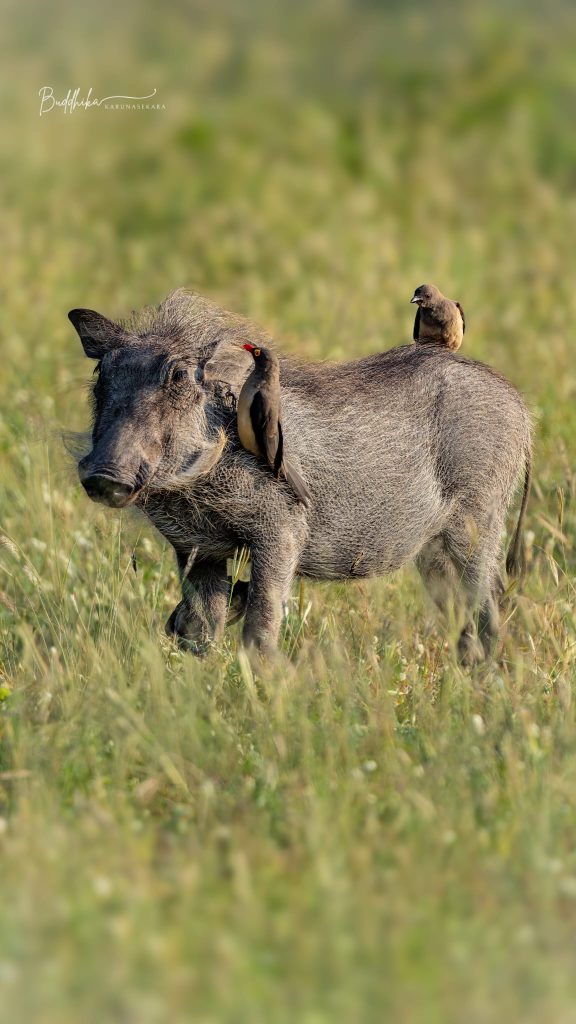
The warthog is a widespread and highly recognisable wild pig found across sub-Saharan Africa. Known for its distinctive facial “warts,” curved tusks, and sparse mane, the warthog is well adapted to open savannahs, grasslands, and woodland areas. Despite its somewhat rugged appearance, it is primarily a herbivore, feeding on grasses, roots, and bulbs, often kneeling on its front legs while grazing.
Warthogs live in small family groups called sounders, typically made up of females and their young, while adult males are more solitary. They make use of abandoned burrows, often those of aardvarks, retreating into them for shelter and protection. When threatened, warthogs can run at surprising speed, usually with their tails held upright, and will often back into burrows so they can defend themselves with their tusks if necessary.
Across various African cultures, the warthog has been associated with resilience, adaptability, and survival. Its ability to thrive in harsh environments, withstand drought conditions, and make use of available shelter has led to it being viewed as a symbol of resourcefulness. In some traditions, the warthog represents the idea of making the best of what is available, rather than seeking comfort or abundance.
In parts of Southern and Eastern Africa, stories describe the warthog as a cautious but determined animal. Folklore often highlights its habit of retreating into burrows and emerging only when it is safe, portraying it as a creature that survives not through strength alone, but through awareness and strategy. These stories are sometimes used to teach lessons about patience, vigilance, and knowing when to act or withdraw.
The warthog’s appearance has also influenced its place in storytelling. Its prominent tusks and facial features have led to it being depicted as both comical and formidable. In some tales, it appears as a stubborn or headstrong character, while in others it is portrayed as underestimated, using its speed and instincts to outwit predators.
In more recent popular culture, the warthog gained global recognition through the character Pumbaa from The Lion King. Portrayed as friendly, loyal, and carefree, Pumbaa introduced a lighter, more humorous interpretation of the animal to international audiences. While this depiction differs from traditional folklore, it still reflects underlying themes of resilience and companionship that align with how the warthog is viewed in many African narratives.
In certain communities, the warthog is linked to the land itself. As a grazing animal that shapes vegetation and uses burrows that are later shared by other species, it plays a role in maintaining the balance of its environment. This ecological role has contributed to its representation as part of the natural cycle of the savannah, rather than as a dominant or feared creature.
Today, while the warthog may not hold the same symbolic weight as some of Africa’s larger animals, its presence in folklore reflects a broader understanding of survival in challenging landscapes. These traditional perspectives align with modern ecological views, recognising the warthog as an important and adaptable species within Africa’s diverse ecosystems.