
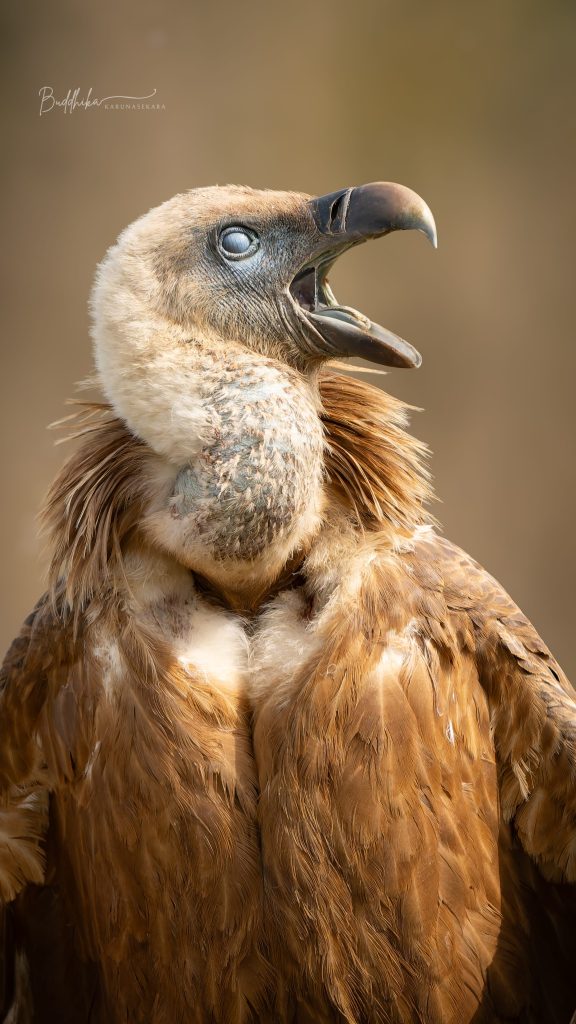
The griffon vulture is one of Europe’s largest birds, soaring effortlessly above mountains, valleys, and open landscapes in search of carrion. Found across southern Europe, North Africa, the Middle East, and parts of Central Asia, this impressive scavenger is instantly recognisable by its broad wings, pale plumage, powerful hooked bill, and distinctive white ruff around its neck. Unlike birds of prey that actively hunt, griffon vultures rely almost entirely on animals that have died naturally or been killed by predators, making them one of nature’s most efficient recyclers.
Griffon vultures are highly social birds, often nesting in large colonies on steep cliffs and gathering in groups to feed. Their exceptional eyesight allows them to locate carcasses from great distances, and they frequently watch one another’s movements, with a single bird descending to a carcass often attracting dozens more. Despite their imposing appearance, griffon vultures are remarkably specialised for scavenging and rarely pose any threat to healthy animals.
Throughout history, griffon vultures have occupied a complex place in human culture. Their close association with death has often led people to view them with suspicion, yet many ancient civilisations regarded vultures with admiration and respect. Rather than representing death itself, they were often seen as creatures that restored balance by returning what had died to the natural world.
In Ancient Egypt, vultures were powerful symbols of protection and motherhood. Although the species most commonly depicted in Egyptian art was the Egyptian vulture rather than the griffon vulture, large vultures in general became associated with the goddess Nekhbet, the protector of Upper Egypt. She was often shown spreading her wings over pharaohs as a sign of divine guardianship and authority. These images helped establish the vulture as a symbol of care and protection, contrasting sharply with later European perceptions.
Among the ancient Greeks and Romans, vultures were sometimes regarded as birds of prophecy. Their soaring flight and remarkable ability to locate carcasses seemingly out of nowhere inspired the belief that they possessed knowledge beyond human understanding. Augurs, priests who interpreted the movements of birds to predict future events, occasionally regarded vultures as significant messengers whose appearance could carry symbolic meaning.
Across the mountains of Spain, France, and the Balkans, griffon vultures became woven into local folklore as guardians of remote wilderness. Shepherds who spent their lives among high cliffs often recognised the birds as an essential part of the mountain landscape. Although their presence could be unsettling, circling high above a valley or gathering around a carcass, they were also understood to perform an important task by removing dead animals before disease could spread.
In parts of the Caucasus and Central Asia, vultures have long appeared in traditional stories as symbols of patience and endurance. Unlike hunters that pursue prey with speed or strength, the griffon vulture survives through careful observation and remarkable efficiency. These qualities have sometimes been interpreted as lessons in waiting for the right opportunity rather than acting with haste.
The griffon vulture has also featured in religious traditions where scavenging birds are viewed as part of the natural cycle of life and death. In regions where sky burials have been practised, particularly across parts of the Tibetan Plateau, large vultures are regarded as essential participants in returning the body to nature. While Himalayan griffon vultures are the principal species involved in these ceremonies, the broader cultural respect shown towards vultures reflects an understanding of their ecological importance rather than fear of their association with death.
In more recent centuries, however, vultures often acquired an undeservedly negative reputation. Their habit of gathering around dead animals led some people to associate them with misfortune or ill omen. Literature and popular culture frequently portrayed vultures as sinister or greedy, reinforcing misconceptions that overlooked their essential ecological role. In reality, griffon vultures neither kill healthy livestock nor spread disease. Instead, by rapidly consuming carrion, they help prevent harmful bacteria and pathogens from multiplying in the environment.
Ecologically, griffon vultures are among the most important scavengers in the natural world. Their highly acidic digestive systems allow them to consume carcasses that would be dangerous to many other animals, destroying harmful bacteria in the process. By removing dead animals quickly and efficiently, they reduce the risk of disease spreading among wildlife, livestock, and even people. Their presence is often an indicator of a healthy ecosystem where natural processes are allowed to function.
Today, the griffon vulture is increasingly recognised as one of Europe’s great conservation success stories. Once driven into decline by persecution, poisoning, and habitat loss, populations have recovered in many regions through legal protection and dedicated conservation efforts. The sight of griffon vultures soaring above mountain ranges once again reflects not only the resilience of the species, but also a growing appreciation for the vital role scavengers play in maintaining healthy ecosystems. The folklore surrounding the griffon vulture reminds us that animals associated with death are often, in reality, among nature’s greatest custodians of life, helping to keep landscapes healthy by ensuring that nothing in nature goes to waste.