
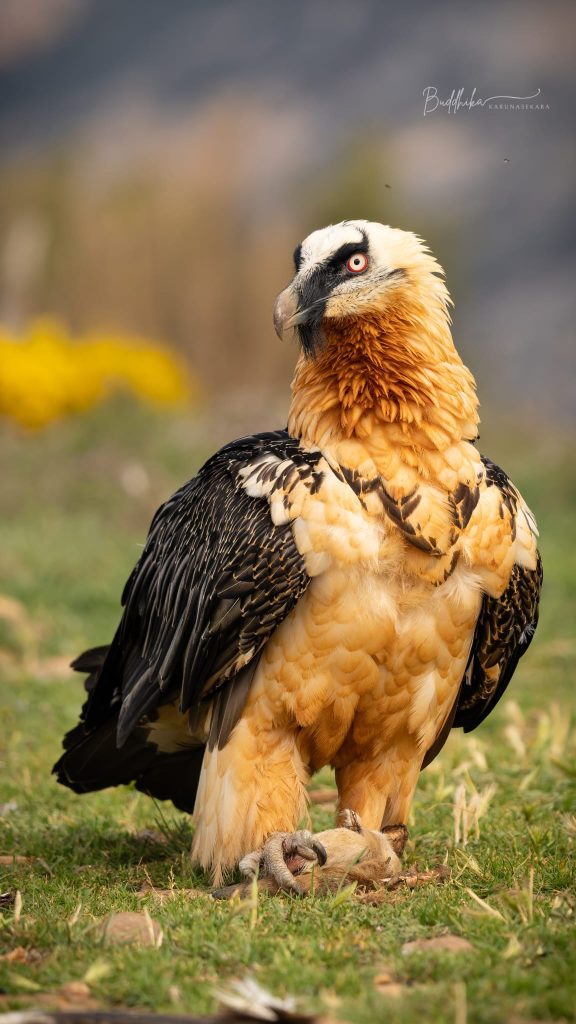
The bearded vulture, also known as the lammergeier, is one of the world’s most remarkable scavenging birds. Found across mountain ranges in Europe, Africa, the Middle East, and Asia, it inhabits rugged cliffs and high-altitude landscapes where few other large birds can thrive. Recognisable by its striking wingspan, rust-coloured plumage, and distinctive black facial markings that resemble a beard, the bearded vulture occupies a unique ecological niche. Unlike almost every other bird of prey, it feeds primarily on bones, swallowing smaller ones whole and dropping larger bones from great heights to crack them open and reach the nutritious marrow inside.
Bearded vultures are typically solitary or found in pairs, occupying vast territories within mountainous regions. They build large nests on inaccessible cliff ledges and may use the same nesting site for many years. Their ability to soar effortlessly on mountain thermals and their specialised diet have made them one of nature’s most extraordinary scavengers, helping to recycle nutrients and keep mountain ecosystems clean.
Throughout history, the bearded vulture has inspired a mixture of admiration, mystery, and superstition among the people who have shared its mountainous home. In many alpine communities across Europe, the bird’s immense size and habit of carrying bones high into the air gave rise to stories portraying it as a powerful and formidable creature. Before its behaviour was fully understood, some believed it was capable of carrying away lambs, goats, or even small children. These beliefs contributed to the German name Lammergeier, meaning “lamb vulture”, despite there being no reliable evidence that the species regularly hunts healthy livestock.
In the Alps and the Pyrenees, these stories led to centuries of persecution. Farmers and shepherds often regarded the bird as a threat to their flocks, and by the early twentieth century it had disappeared from much of Western Europe. Modern research has shown that these fears were largely unfounded, with the bearded vulture relying overwhelmingly on carrion and bones left behind by other predators or animals that died naturally. Conservation and reintroduction programmes have since helped restore the species to parts of its former range, transforming it from a symbol of fear into one of Europe’s greatest wildlife recovery stories.
Across the Himalayas and the Tibetan Plateau, vultures occupy an important place in local traditions and Tibetan Buddhist culture. During traditional sky burials, the bodies of the deceased are offered to scavenging birds as a final act of generosity and as a reminder of the impermanence of life. Although Himalayan griffon vultures are the species most commonly associated with these ceremonies, bearded vultures also inhabit many of the same mountain regions. More broadly, vultures are often regarded as creatures that help return the body to nature and maintain the natural cycle of life.
In parts of Ethiopia and the Horn of Africa, the bearded vulture has long been admired for its mastery of the mountains. Its ability to soar at extraordinary heights and its preference for remote cliff faces have linked it with ideas of endurance, freedom, and resilience. The bird is also well known for deliberately bathing in iron-rich soils, which stain its normally pale feathers a vivid orange. Scientists are still investigating why it does this, with proposed explanations including social signalling, mate attraction, and feather care. Whatever the reason, the behaviour has contributed to the bird’s striking appearance and has inspired generations of local stories and speculation.
Among mountain communities in Central Asia, the bearded vulture is sometimes associated with wisdom and patience. Its remarkable feeding strategy of repeatedly dropping large bones onto rocks until they break has made it a symbol of persistence and ingenuity. Rather than relying on brute force, the bird succeeds through experience, precision, and an intimate understanding of its environment.
Unlike many birds of prey that are celebrated for their hunting ability, the bearded vulture has often been admired for making use of what other animals leave behind. In this sense, it represents renewal rather than destruction. By consuming bones that few other animals can digest, it completes one of nature’s final stages of recycling, ensuring that valuable nutrients are returned to the ecosystem.
The bearded vulture has also become an important symbol in modern conservation. Once driven close to extinction across much of Europe through misunderstanding and persecution, it is now the focus of successful reintroduction programmes in countries including Switzerland, France, Austria, and Spain. Today, seeing a bearded vulture soaring above the Alps is considered one of Europe’s great wildlife spectacles and a testament to decades of conservation work.
Ecologically, the bearded vulture performs a vital role as a specialist scavenger. Around seventy to ninety per cent of its diet consists of bone, making it the only vertebrate known to feed primarily in this way. By consuming bones that would otherwise remain in the landscape for years, it helps recycle calcium and other nutrients while reducing the accumulation of animal remains. Its specialised diet also means it competes very little with other scavengers, occupying a unique position within mountain ecosystems.
Today, the bearded vulture stands as one of the most distinctive birds in the natural world. Once feared through misunderstanding and legend, it is now recognised as an essential part of healthy mountain ecosystems. The folklore surrounding the species reflects humanity’s long fascination with animals that inhabit remote and dramatic landscapes, while modern science has revealed the true nature of a bird whose greatest strength lies in completing one of nature’s most remarkable recycling processes. By consuming bones that few other animals can digest, the bearded vulture helps return valuable nutrients to the ecosystem, supporting the continual cycle of life in some of the world’s harshest environments.